Model
Model tree
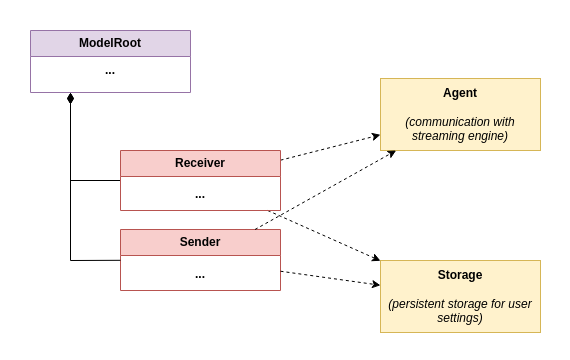
Models are arranged into a tree, starting with ModelRoot class.
Currently there are two model classes:
-
Sender - captures local audio device or sound played by local apps, and streams it to remote peer
-
Receiver - receives stream from remote peer and plays to local audio device
Models don't actually work with the audio, they only provide abstraction for UI to manipulate corresponding functions of Agent (which interacts with the streaming engine).
Models also interact with Storage to save configuration persistently and restore at start.
MobX
Models are implemented with mobx reactive framework.
Model classes fields are observable: when they're modified, affected parts of the widget tree are automatically rebuilt.
These classes follow a few simple rules:
- model classes should derive from mobx
Store - state that affects UI (private or public) should be annotated with
@observable - methods or getters which result depend on that state should be annotated with
@computed - methods that mutate that state should be annotated with
@action
The UI code, in turn, should wrap sub-trees to be automatically rebuilt with mobx Observer.
Please consult mobx documentation for further details.
Model vs. DTO
In our code base, a model is an active (reactive) object that abstracts some part of the system for the UI. It has state and it communicates with the real world (e.g. with the streaming engine).
We also have dto package, which contains common data transfer objects - plain data types without any behavior. These DTOs are widely used in the code: for example, SenderConfig is used by Sender model (in private fields), Storage (to read/write config), and Agent (to enable streaming).
Usually DTOs are immutable objects and models store them as a private @observable field updated atomically. When the model needs to update the field, it should replace the whole DTO with an updated one.